
How to Find New Outdoor Walking Trails
I love being outside. Finding new outdoor walking trails is important to me because I get bored easily. I found a new walking trail in Alpharetta, GA and I loved it. I’ll definitely go back. I looked up trails on Google and then looked up cities that I wanted to explore. Here’s how to find new outdoor walking trails for wherever you live.

How To Find Outdoor Walking Trails
- Utilize Online Trail Databases and Mapping Apps. A highly effective way to find local walking paths is by searching dedicated trail websites and mobile applications like AllTrails, TrailLink, or MapMyWalk. These platforms use crowdsourced data and official information to show maps, difficulty ratings, user reviews, and photos for trails near your current location. Simply download an app, enable location services, and search for “walking trails” or “parks” to instantly see available routes, ranging from paved urban paths to rugged nature hikes.
- Consult Local Government and Park Department Websites. Check the official websites for your city, county, or regional Parks and Recreation departments, as they are the authoritative source for local public lands. They often have comprehensive maps and guides for municipal parks, greenways, and nature preserves, including information on operating hours and facilities like parking or restrooms. These resources can lead you to lesser-known local gems that might not be as heavily advertised as major tourist destinations.
- Search on Social Media and Community Platforms. Use platforms like Facebook, Meetup, or Instagram to find local walking groups, hiking clubs, or community forums where residents share their favorite routes. Searching hashtags such as “#[YourCity]Walks,” “#LocalTrails,” or “#OptOutside[YourState]” can reveal hidden pathways and walking spots frequently used by locals. These communities often provide real-time updates on trail conditions and suggestions for the best scenic routes.
- Look for Multi-Use Paths and Former Rail Trails. Many regions have transformed abandoned railway lines into linear parks, known as rail-trails, which offer flat, often paved or well-surfaced routes ideal for walking and jogging. Similarly, search for local “greenways” or “multi-use paths,” which are often paved corridors connecting parks or neighborhoods. These paths are usually easy to access, well-maintained, and provide a safe walking experience away from vehicular traffic in both urban and suburban areas.
- Ask Local Experts and Businesses for Recommendations. Don’t underestimate the power of word-of-mouth from people knowledgeable about the immediate area. Ask staff at local sporting goods stores, nature centers, or even a public library, as they often have insider knowledge about local walking spots and trail systems. Local running or walking clubs are also excellent resources, as their members have likely explored every safe and interesting outdoor route nearby.
Keep Safety First on Outdoor Walking Trails
Wherever you decide to go remember to be safe and go first in the daytime. Maps generally do not tell you if a place is dangerous! When I visited my new trail in Alpharetta, I took photos of where I parked and I also made sure my “Find My” was on so I could find my car when I was done. I do not like getting lost. Here are some tips of how to be safe when going to a new trail for first time.
- Prioritize Navigation by Pre-Downloading Your Route and Parking Spot. Before leaving home, look up the trail map online. Use an app to download the route for offline use, as cell service can often be non-existent on the trail. Upon arriving, immediately use your phone’s map or a simple picture to mark the exact location of your parked car. Note any distinct landmarks near the trailhead. This ensures you can always navigate back to your vehicle even without a cellular signal. This is a critical step in preventing disorientation at the end of your walk.
- Hike During Daylight and Set a Firm Turn-Around Time. Plan your visit to start early enough to complete the entire walk well before dusk. Hiking in low light dramatically increases the risk of tripping or getting lost. As a safety measure, calculate half of the time you have available (or half of the estimated round-trip time) and make that your definitive turn-around point on the trail. Sticking to this schedule guarantees you have adequate daylight to safely return to the trailhead and your car.
- Use Visual Cues for Constant Situational Awareness. Actively scan the trail and surrounding area for unique or memorable landmarks like a uniquely shaped tree, a distinctive rock formation, or a bridge. Take a quick photo of these features as you pass them. Create a visual “breadcrumb trail” that you can review if you start to feel uncertain of your direction. Additionally, look behind you occasionally to see what the trail markers and landmarks look like from the reverse perspective, which is crucial for successful backtracking.
Take Photos
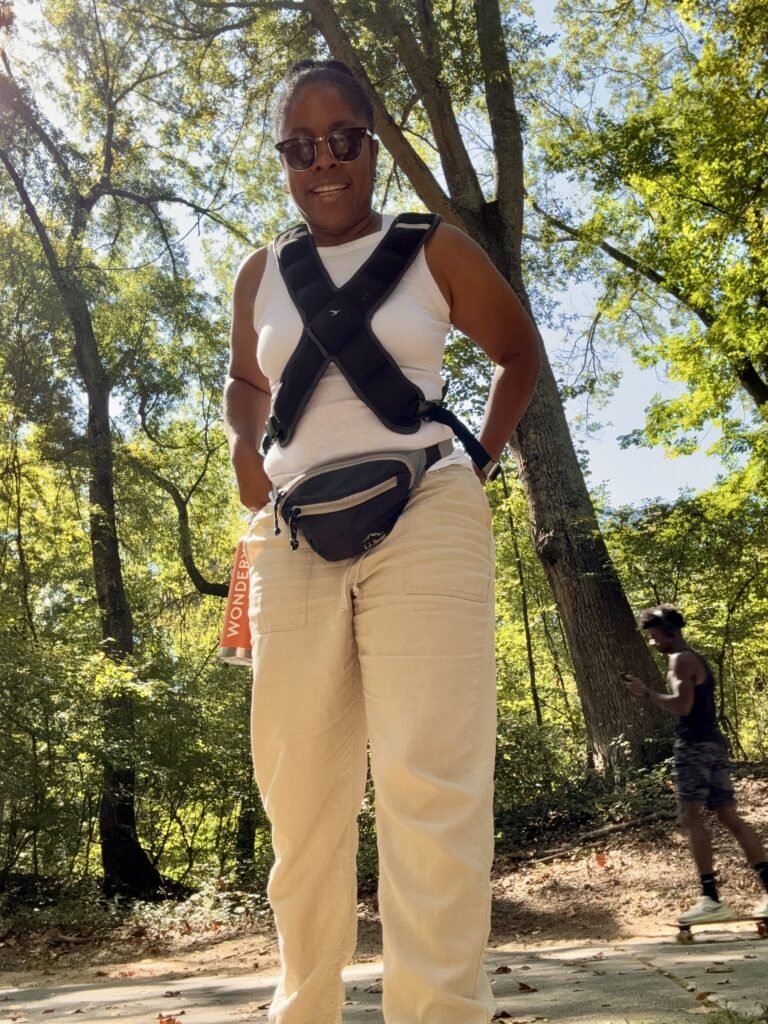
I shouldn’t have to say this, but babe, TAKE PHOTOS! Take photos of landmarks. Get a selfie when you’re on the outdoor walking trails. Take photos so we can see and you are documenting where you are. This is so important for posterity and it’s a good look! Also, if you’re going to a new place, text a friend or family member so they know where you are and send them a photo. Yes, photos are a part of your safety.
I used my 8 lb weighted vest on this walk. Because I didn’t know how challenging this new trail would be, I wanted to use my lightest vest. Remember, when you are going on unfamiliar terrain, to carry water and travel light. I also carried my fanny pack which had mace and dog spray inside. We never know what we’re going to run into.
Let me know if you find a trail that you want to share. See you next time. –Yasmin